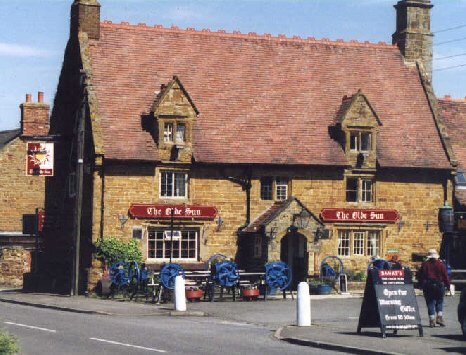
This kind of pub keeps us
going. A gorgeous-looking 18th Century building, all golden
hues in the Springtime sunshine, in a lovely Northamptonshire
village. Had we not been told to avoid the other pub, the one
that looks out on the Green, we may never have discovered this
one.... that and having been told to go to the Sun anyway. The
people at Eastcote told us to miss out on the other pub in
Nether Heyford (the Foresters), and when I asked them why,
they told me, "Oh, you don't want to know." To which I
replied, entirely factually, "Well actually, yes I do." This
seemed to stun them for a moment, but only a moment. "No you
don't." Whereupon, I could see down which nightmare avenue
this conversation was heading, and promptly left.
And
here I must digress. I never did make it to the Foresters, and
based on an email I received from Shirley W., maybe I should.
A poor opinion of a pub on this site is one thing, but a poor
opinion of a pub I have never visited? Unforgivable! Here is
Shirley's contribution, in full:
Have just been reading the article about the Sun Inn,
Nether Heyford. Very interesting website ! The Sun is indeed a
lovely pub. However I was dissappointed to read the comments
about the 'other pub' (actual name the Foresters)which I
assume you have never been to. Your comments suggest it is
pretty dire. Although not as appealing as the Sun it is not
that bad ! The previous tenants were very friendly, and the
pub had a regular local clientel. It has recently been taken
over by a young couple who are doing their best, are very
pleasant, provide good, interesting food and OK beer although
not lots of variety. Its probably a bit lacking in atmosphere
but hopefully that will come. I feel the comments on your
website are unjustified and will put people off even giving it
a try which is sad. Your articles are best when promoting the
positive and unless you have an actual bad experience to
report rather than hearsay I would be very happy if you could
make some adjustment here - maybe just take reference to the
Foresters out completely.
With thanks, Shirley Waterhouse
(member of the church bellringers who visit after practice
night and have been made very welcome at the Foresters for
many years)
Whether my review of a pub is good or
bad, I do strongly encourage you to at least try it. You may
discover a gem -- pubs change hands, and in new hands can be
transformed. And besides, it is just my
opinion.
Anyway, back to business. The Sun Inn is lovely, and
old, and full of small rooms, complete with an unusual
small bar sort of stuck in the middle. While the slightly
cold temperature of the Ruddles was acceptable today,
our recent bad run of ciders continued unabated.
The Green at Nether Heyford
is a national treasure, reputedly being the largest
Village Green in the country. Now, I always thought
that common land, as every village green is supposed
to be, was freely accessible to all. Not quite so.
The term ‘Common Land’ is often used to
describe any land in public ownership or which people
regularly access. It is neither. Land must be legally
registered as a common to enjoy such status.
A popular belief is that
any person has a right to wander on and use common
land. There are some chunks of land where this is
the case, but not usually. Surprisingly, the laws
of use and trespass as applied to private land are
often the same as for common land, except for certain
people who possess commoner’s rights. This is
a complex and very variable part of the law (in other
words, so old everyone has forgotten how it works),
and you cannot technically go grazing your goat on
common land, though people do, and no one really seems
to mind. Until it becomes twenty goats.
Common land is subject
to ‘rights of common’. Examples of such
rights would be the right to graze certain stock or
the right to collect wood or turf. These rights belong
to individuals (the ‘commoners’), not
to everyone. Often the rights have died out, and a
common has no commoners; or if the commoners exist
by inheritance, they no longer exercise their rights.
This does not stop the land from being a common, just
that there are no commoners around to exercise their
rights or their goats.
But who the heck are these
commoners? Are we not all commoners? No. Commoners
were specified individuals granted the right to share
this piece of land with other commoners, with the
stipulation that they only graze this much, or take
this much wood or whatever. From what I can gather,
95% of the people who use the common land have not
been specified as having the right to the land, but
instead there is a nod & a wink agreement that
anyone can use the common land. The subconscious cultural
effect has been, through the generations, that the
English pretty much revere the Village Green.
It gets better. Not all
common land is land (now that we have established
that common land is not common either). It can be:
• Of pasture. The right to graze livestock,
but not just willy-nilly, as it was always specified
which animals were permitted, whether they were sheep,
horses, cattle, or whatever.
• Of estovers. The right to cut and take wood
(but not entire trees), reeds, heather, bracken, pretty
much anything green or mildly woody.
• Of turbary. The right to dig turf or peat
for fuel, and, apparently the right to use words which
most English-speaking people have long forgotten.
Turbary? The English have such a way with words!
• Of the soil. The right to take sand, gravel,
stone, coal, or minerals.
• Of piscary. The right to take fish from ponds
or streams.
• Of Pannage or Mast. This right really only
applies to the New Forest, but it is such a neat-sounding
Right, that I just had to include it in here. It allowed
pigs to graze in the forest from September 25th to
November 22nd each year.
There are a number of other
Rights scattered throughout the country (Fern Rights
and Marl Rights, for example), but the ones given
here will cover most of your needs should you ever
wish to exert your Rights.
All this is glorious.
People embrace the principle of common land as English
essence, yet hardly anyone understands it.
The distinct lack of clearly-defined
written law on all this and the subsequent confusion,
led in 1955 to the setting up of a Royal Commission
on Common Lands, a great little number for some aging
politicians. The way around establishing what had
been deemed common was to basically start again, and
get each parish to register all the land they thought
was common by 1970. The Brits sometimes move a little
slowly, but allowing fifteen years to get the paperwork
done does seem a little excessive.