By London standards, a
little discovery.
We nearly missed
it. Marylebone High Street, like most streets in London,
is one long line of buildings with no break between
them, a terrace of six-story buildings the entire
length of the block. Each had its own architecture
and color, but you have to pay attention to differentiate.
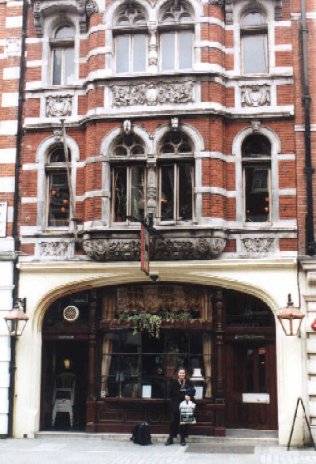
The Black Horse is a particularly attractive brownstone
building with arched windows and elaborate detail.
We went in with a plan
in mind. Half a pint in a pub meant that we could
visit many, many pubs in a day, so we ordered halves.
Mid-way through the first half, I knew we were staying
for more. Nothing but locals in at the bar, young
lads serving who knew the punters by their first names,
old guys and young guys mixing well. Good beer (Timothy
Taylors Landlord), high ceilings, old fixtures, traditional
pub velvet-covered bench seating, but most of all
a very relaxed, friendly, accepting atmosphere that
virtually insisted we stay.
I even chatted with an
old gentleman at the bar. He had been coming here
for 62 years, and would not go anywhere else. They
even help him across the High Street when he is ready
to go home. In the middle of one of the largest cities
in the world, here was a local pub.
Marylebone is
an interesting little neighborhood and one that we
have had the opportunity to explore a little, usually
on our way to and from feeding the ducks in Regents
Park.
The name Marylebone
dates back to the Fourteenth Century when the area
was a very rough area that was out of bounds to most
decent Londoners. The local church at Tyburn was continuously
being attacked and the desperate parishioners successfully
petitioned the Bishop of London to build them a new
church half a mile away. This new church was called
St. Mary's-by-the-Bourne (the River Tyburn was originally
called the River Tybourne), which became shortened
to Marylebone. A bourne is an old word for a stream
that only runs in winter.
The district's
most infamous historical feature for many years was
the notorious gallows, nicknamed 'The Tyburn Tree'.
From its first use in 1388, the majority of London's
public executions were held here. It was an elaborate
three-legged affair that could quite efficiently dispatch
twenty-one felons at a time. The approximate site
of the gallows is marked by a plaque on the traffic
island at the junction of Bayswater and Edgeware roads.
Most of the people executed
had been held in Newgate Prison and during the four
hundred years that the gallows stood, it is said that
fifty thousand people died there. Such was its reputation
and aura of death, that people refused to move into
the area, and for a long time no real development
took place here. Finally the gallows were dismantled
in 1780, and the neighborhood started to improve and
expand.
Marylebone High Street itself is a little unusual
in that is not at all straight. This is because the
High Street and Marylebone Lane, which linked the
original village to London, was developed alongside
the winding River Tyburn, now completely covered over.
The High Street
actually offers a rather pleasant pub-crawl as recommended
by John Rogers:
Traveling sequentially to the Rising Sun (79 Marylebone
High Street);
Marylebone Tup (93 Marylebone High Street);
Bricklayers Arms (33 Aybrook Street);
Black Horse (109 Marylebone High Street);
Prince Alfred (118 Marylebone Lane);
Golden Eagle (59 Marylebone Lane).
This would indeed offer a patron a splendid evening
of entertainment.