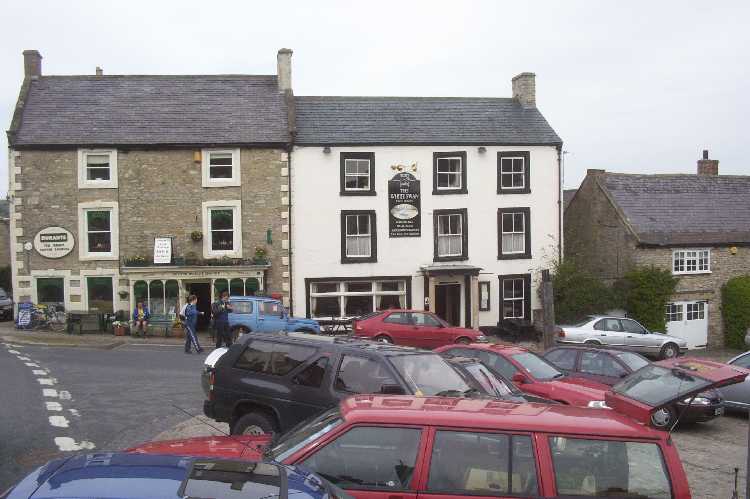
At the wide end
of Coverdale stands Yorkshire's smallest town, Middleham.
Appealing to me for several reasons: It means we are
nearly in Coverdale, the best Dale of all; there are
three pubs huddled around the small market square;
and there is a whole pile of history in the form of
Middleham Castle.
The three pubs
are the White Swan, the Black Swan and the Black Bull.
I seem to only be able to manage one pub per visit,
since I hit the Black Bull on a Millennium Trip, and
the White Swan this time around. All three look appealing
enough to try.

A couple of years
ago the whole top half of the pub was lost to a considerable
fire, and the owners took the opportunity to not only
upgrade the accommodation, but also refurbish and
upgrade the entire pub, with the result that this
is now an up-market establishment, with just a few
signs of its roots in the stone floors in the bar
and a few oak beams.
So with the Black
Bull being blacklisted due to unpleasant locals and
no food (a completely separate story that occurred
during the Millennium visit), and the White Swan being
a bit too snobby for my tastes, that leaves just the
Black Swan on my list for our next visit, which will
doubtless occur on our next trip. I will report accordingly.
The Theakstons
beer took some time to clear, perhaps because it was
served too cold. Temperature can do that, but so can
unwelcome and uninvited components in the beer when
the beer is masquerading as Real Ale. Good Real Ale
is not naturally cloudy nor naturally flat, but has
a degree of clarity and slight effervescence. I figured
by letting it stand it would improve. That gave me
the opportunity to overhear a conversation where some
visitors were making reservations for dinner at eight.
In a pub?? Reservations?? Oh, I suppose in this pub
reservations are needed, but it would certainly cause
a chuckle if I made a reservation in Thwaite Arms,
a real pub. By heck lad, I would be the laughing stock!
From the front
window of the White Swan you can see the impressive
profile of Middleham Castle. There was a wooden castle
here about the time of the Norman Conquest, which
was improved in 1170 into more durable and imposing
stone structure. But it was the 1400s that saw Middleham
Castle=s heyday when Richard III, or Richard the Kingmaker,
made the castle his home and a prison for all those
who ticked him off. Edward IV was twice a guest of
the Kingmaker, on the second occasion, for two months
in 1469, unwillingly.
In the 1400s there
would have been no buildings separating the castle
from the market square, and the fortifications would
have been a formidable sight. Today, as a ruin, you
can still imagine it quite vividly.
Richard III was
involved in some of the most important battles in
English history. On August 21, 1485, Richard III left
Leicester to intercept Henry Tudor’s invading
army. Their respective forces met and fought at Redemore
Plain, somewhere south of Market Bosworth in Leicestershire,
early the following day. Betrayed by the Stanleys
and Northumberland, Richard was killed at the Battle
of Bosworth Field during a fateful charge at Henry
Tudor's ranks.
Typically, when
it comes to English history, there is some discussion
on who betrayed whom and the Northumberlands and the
Stanleys have fought to clear their name ever since,
claiming that the terrain and the timing prevented
their immediate assistance. As if that were not all
enough to chew on, the Battle of Bosworth Field may
not have taken place on Bosworth Field at all. Dadlington,
a town about one and a half miles to the south, is
a strong candidate for the actual battle site. The
earliest sources call the battle's location 'Redemore',
which is derived from an Old English phrase meaning
'reedy marshland', and a document from 1209 refers
to Redemore as being in the fields of Dadlington.
Adding weight the Dadlington case, the greatest number
of human skeletons, arrowheads, pieces of weaponry
and other signs of carnage and mayhem from the battle
have been dug up in the area of Dadlington/Stoke Golding
rather than Ambien Hill (or Ambion Hill, not even
the spelling of the name of this site is undisputed),
the traditional site of the struggle.
According to
William Burton, a local Seventeenth Century historian,
the battle was christened 'Bosworth' after the most
notable town in its vicinity, much in the same way
the Battle of Agincourt got its name from a nearby
castle. This issue still divides traditionalists (those
who think the battle was fought at Ambien Hill) and
revisionists (the Dadlington crew). Some historians
have accepted a compromise scenario in which the battle
starts out at Ambien Hill and moves into Dadlington
when the Yorkists are routed.
Apparently, grown
men still fall out with each other arguing about this
in pubs, which is a clear indication to me that there
is simply not enough stuff to do in England. Or there
is another explanation, as was discussed in the section
on pub etiquette. One can quite properly get all worked
up about Ambien!! Dadlington!! Ambien!! then turn
around and buy your adversary a pint (assuming it
is your round), but what if it is some truly important
issue, like those that employ the services of the
Supreme Court on a regular basis. Often those issues
are not even open to debate, they are core beliefs
that that are not influenced by discussion, drunk
or sober, social or political. We can drink ale and
argue the relative merits of various characters in
history, even vociferously, because when all is said
and done, it is not the success or failure of the
argument that is important, it is that we are still
discussing it several hundred years on.
The English have
a lot of history. But they have a split personality
when it comes to paying homage to that history. I
struggle to find the first names of any of my family
members beyond my grandfather (a fine, heroic, bemedaled
merchant seaman called George William Whyte by the
way), while my wife, an American with seemingly so
much less history, can trace her roots in written
record way back to Germany, Scandinavia, native America,
England and Scotland with birth dates and places for
all the ancestors all along the way.
The English take
so much history for granted. Remember the Roman road
above Dentdale? It was just sitting there, presumably
with sheep sitting on it in good weather. We walk
through a farmyard, and the shed where the animals
are kept has a lintel with 1569 engraved on it. History
is not so much in the past as it is just another part
of where we are now.