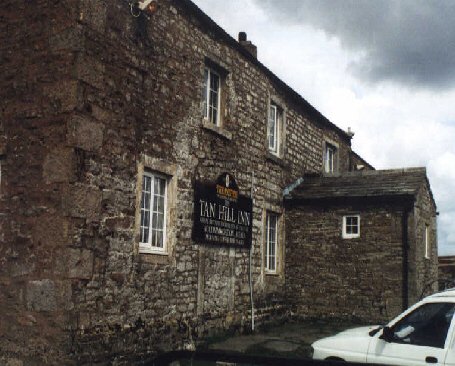
Ah, Tan Hill!
The very name conjures up pictures of wet, windswept
walkers stumbling through the door off the moors,
and warming themselves by the fireplace. This is certainly
the highest pub in England at 1732 feet above sea
level, and there can be few contestants for the title
of bleakest, most remote pub in the nation, if there
was a contest for it, which there isn't.
The locals still talk of
the day Tan Hill Pub got a generator installed so
they could have electricity. It is still not hooked
up to the mains, nor will it ever be, I believe. Nor
should it be, because this is a symbol of all that
is good about Dales Pubs.
The first mention
of a pub on Tan Hill was by William Camdem in his
guidebook 'Britannia' in 1586. The keeping of records
in the area was poor at the time because Upper Swaledale
was an area to be avoided due to the treacherous weather
at the time caused by a period of global cooling called
the 'Little Ice Age', which occurred again in April
2000 as the 'Little Wet Age'. William the Conqueror's
grumbling surveyors compiling the Domesday Book in
1085 wrote the area off as wasteland, and once you
have trudged across the moors in boots and waterproofs,
attempting the Pennine Way, you can see what they
meant.
The current inn
was built sometime during the Seventeenth Century
and during the 1800’s it did a roaring trade
from the coal miners and packhorse drovers or jaggers.
The local coal was a poor quality crow coal which
produced a dirty dusty fuel but "…many
a farm wife preferred the small dusty outcrop coal
which when mixed with peat, burns with a heating glow
and can be banked up at night, and with a little poking,
made bright as ever in the morning". The last
mine closed at Tan Hill in 1929, the workers having
defied the nationwide General Strike of 1926. Following
the Strike better coal reached Swaledale on the improved
roads and mining at Tan Hill ceased to be economically
viable. Pit ponies were often used in the local mines
and surprisingly, pit ponies continued to be used
in small independent Welsh mines until the late 1990's.
Tan Hill Inn certainly
had its share of licensees. The longest serving was
Susan Peacock who ran the pub between the two World
Wars. She was born in the pub and local legend has
it that she is buried behind it. During that time
the inn was a rough place and fisticuffs would often
break out between the miners..... Susan Peacock kept
a loaded pistol behind the bar for such occasions.
They are clearly
proud of their pub history. Many bits and pieces from
that history, particularly from Susan Peacock's reign
as landlady, may be viewed at Swaledale Folk Museum
in Reeth, ten miles away to the east. The new dining
room has been decorated with all kinds of photographs
from the pub's past. The dining room bothers me though,
as it has been an ongoing construction project for
the past couple of years, and has not had a chance
yet to weather in (say a century or so). I understand
why they have to built additional facilities, as the
demand is certainly there during clement weather,
but there seems to have been little if an effort put
into making the addition have anything in common with
the wonderful, low-slung, cramped, rough, eclectic
little bar.
During the 1970's
and early 1980's people would buy the pub, but sell
up after only one unpleasantly educational Yorkshire
winter. Beer would freeze in the pipes and water was
only available from a spring. There was (and still
is) no mains electricity, and we could hear the generator
humming away behind the pub. The pub stands alone
on top of the moors, so there were no immediate neighbors
to come and help you shovel your driveway. You could
be alone for days. Life could indeed be harsh.
When I had the
pleasure to live and work in the Dales in the early
1980's, the pub had the reputation for being a 'Drinker’s
Pub' in that the beer was good, the occasional company
was good, but the place was pretty much dropping to
pieces. It came up for auction in 1985. Prospective
buyers balked at the pub's condition. The walls were
moldy with the damp, furniture was infested with mice,
and the carpets were unusable. Potential buyers, television
crews, curious onlookers, and some people just wanting
a pint, squeezed inside the pub on Auction Day, when
the auctioneer was "looking for eccentrics…".
Margaret Baines bought Tan Hill for £82,500,
and amazingly, is still there. They have braved every
winter since 1985 and developed the pub so it is now
one of the most welcoming establishments in the Dales,
but my strong advice to you is to try several of the
pubs in the Dales, and compare them for friendliness.