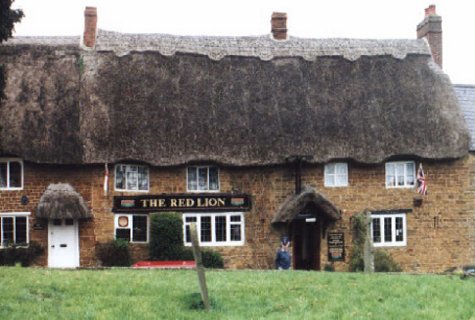
We had been trying for
years to get into this pub. Missed it when it was
closed; drove nearby when we did not have time. Finally
we made it, and a lovely unspoilt, local pub it is
too. Pushed hard up against the churchyard close enough
where a visit to the church is virtually unavoidable.
The pub itself is certainly
used, and is not the protected little museum piece
that some places can become. Yellowing walls, dogs
on the floor, and tiny cramped little tables. Just
the sort of pub I love! The yardstick cider was excellent,
the beer well looked-after. I would have no hesitation
in coming back here again.
Now, here is a great example
of how fascinating these villages can be. One visits
Cropredy because of its historical significance during
the English Civil War, right? The Battle of Cropredy
Bridge in June of 1644 was, after all, a significant
moment in English history.
But what about
the church? One small subject in the church can provide
hours of enlightenment. For example: The vicar of
Cropredy in the late 1800's, the Reverend Canon Wood
wrote an article called 'A Forgotten Saint' in which
he searched for the proof that there was once a shrine
to Saint Fremund in Cropredy church. In the 1870's
no-one in the village had any recollection of one,
but a local resident in the Danvers family had come
across references to Fremund's chapel in three wills.
The first will was that of Richard Danvers of nearby
Prescote Manor who was buried in the church in 1489.
His family's endowment supported a chaplain to pray
for the soul of the departed Danvers, but it was not
entirely clear whether this meant that the prayers
should be carried out Danvers' home, at Prescote Manor
with the family, or at the gravesite at the church
in Cropredy. The will stated:
"..to Sir
Ranulphus chaplain of the chapel of St Frethmund 20
shillings to pray for my soul. I give 100 shillings
to the works of the body or nave of the Prebend church
of Cropredy; 20 shillings towards the repairs of St
Fremund, where his shrine is situated."
Still more evidence:
Richard Danvers' son John had married Ann Stradling
and lived at Dauntsey in Wiltshire to the south-west.
In Dauntsey church, John and Ann have a large tomb
and above it is a stained glass window with a scroll
'Sancte Fredismunde ora pro nobis'. Saint Fremund
is shown carrying his head under his arm. In John's
will of 1514 he left twenty shillings (an English
pound) to Cropredy church and twenty shillings to
St Frethemund’s chapel, while Ann also remembered
the chapel when in 1539 she left a cow to Culworth
church and ten ewes to the 'Chapel of Saynte Fredysmunde
in Cropredy'.
So now we have references
in both the wills Danvers Sr. and Danvers Jr., along
with his wife.
All this was enough evidence
for Dr. Wood. But to seal the deal, he needed to establish
a connection between Danvers and Fremund. Why was
Danvers so hung up on Fremund?
Danvers he knew
all about, but who was this Fremund? How did the legend
arise and how much was altered down the years? Dr.
Wood came across 'Lives of Saints' compiled by John
of Tynemouth in 1366 and copied by some guy called
Hardy. The vicar quoted from this text in his book
'A Forgotten Saint' in 1893. The direct quotes are
from Hardy interspersed with information taken from
Dr. Wood’s interpretation of the tale.
"Fremund
was the son of a pagan king who reigned in England,
named Offa, and his queen Botilda, his birth foretold
by a child, who died when three days old. He is baptized
by Bishop Heswi, performs many miracles, and converts
his parents. Offa resigns his kingdom to his son,
but after a year Fremund left the throne to become
a hermit, taking Burchard and an attendant. For seven
years he remained on Caerleon on the Wye until 870
when King Edmund was killed by the Danes when they
invaded West Mercia. Offa sent twenty-two noblemen
to find and collect his son asking for his help. He
assents in consequence of a vision in which it is
revealed each of his companions shall appear as a
thousand to his enemies. He attacks and defeats 24,000
of the enemy with twenty-four men".
They are of course
talking about a different Offa than the famous one,
the dyke-builder. The Offa's reign ended in 796 AD,
and he did not 'resign the position', he just plain
died, unless resigning is but a euphemism for popping
one's clogs. Offa's son was Ecgferth, but I am not
discounting any relationship to Fremund.
A lot of questions remain
unanswered. Why was the vicar of Cropredy so interested
in an obscure saint from centuries past? Purely academic
interest? Why is so little known about him? Why does
no trace exist today in the church? Why could we never
establish a good link between Danvers and Fremund?
To me, and I hope to you, this is interesting because
it is history, because history leads us to where we
are today.
And so it goes
on. We will come back to Offa again, later in this
book. Had we done our research ahead of time, we would
have known also that the row of houses in which the
pub now sits, was owned by the Whyte family around
1570 to 1640. We could have got a free pint! (maybe...)