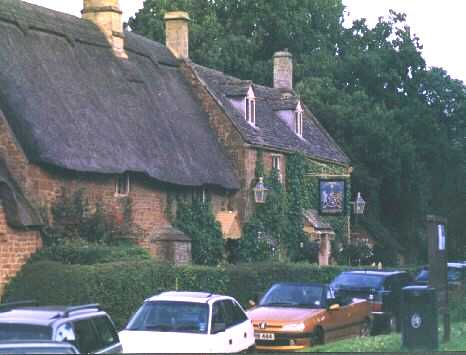
Initial reactions
to pubs are curiously quite often accurate. If a pub
looks okay on first blush, it generally is. If it
looks terrible, you are going to have a bad experience
and have only yourself to blame for not walking away
immediately. There is another category, into which
the Falkland Arms definitely falls: The Instantly
Recognizable Gem.
The instant you
step across the threshold, you find yourself involuntarily
lowering your jaw, and gazing at each new aspect you
discover.
The Falkland Arms
is worth a drive out of your way, and may even be
worth staying at for a weekend, accommodation packages
that are apparently in high demand. It is a lovely
golden Sixteenth Century country inn set in a timeless
Cotswold village of thatched cottages, standing opposite
the green and village school.
The bar sits
as it must have sat four hundred years ago, surrounded
by heavy oak beams, oak settles, an ancient flagstone
floor and a large inglenook fireplace, beside which
we ensconced ourselves. If I had been riding across
England in the 1600’s, stopping off for some
refreshment would have differed very little from the
way it looked this day.
It is just as
if time has stood still.
An eclectic collection
of mugs and jugs hang from the ceiling and eight real
ale pumps (yes, I counted them) poke up from the small
bar dispensing an adventurous range of interesting-looking
beers. Some were standard (Wadworth's 6X, Ruddles)
and some were obscure (Tanglefoot), and encouragingly,
they were all different to the last time we were in
here.
The Scotches
catch my eye every time. They claim seventy types
of Malt Whisky behind the bar, but slightly more interesting
to me is the collection of about a dozen rare cask
strength malts, not for the feint of heart. Legend
has it that there is a list in the pubs of all the
Single Malt Scotches currently commercially available
– and it matches the pub’s whisky list
precisely. Clay pipes and snuff are on sale to complete
the picture in what they call one of the last proper
English pubs. I could reel off half a dozen others
we have discovered besides this one, so that claim
is stretching things a bit. But these pubs are there
to be found.
This pub was named
after a local resident, Viscount Falkland, who was
secretary to Charles I. It used to be a free House,
but has recently been made more specifically into
a Wadworth house. The beers available at the time
of our visit were, Donnington Best, Hook Norton Best,
Wadworth 6X, Hall & Woodhouse and Tanglefoot,
though I would feel comfortable guaranteeing that
they will mostly be different should you ever be lucky
enough to pay a personal visit. There were also five
guest beers.
Close by you can
find the Rollright Stones, standing stones of great
antiquity, and Mark Richards has written a nice little
book that takes you on walks to and around the stones.
The stones are made up of three groups:
The King’s
Men
When the Romans came to Britain, this ceremonial stone
circle was already over two thousand years old. The
King’s Men stand in a perfect circle over one
hundred feet across, straddling a prehistoric trackway
at the edge of a ridge. England is crisscrossed with
these ancient trackways, many of which are confirmed
as ‘ley-lines’, connecting sites of great
antiquity with such accuracy that they must have required
the use of the precise tools of geometry not available
in England at the time of their construction. They
therefore remain a mystery, though it is said that
a surveyor is depicted as the ‘Long Man of Wilmington’,
a chalk outline of a man carrying two long sticks,
supposedly surveying stakes.
The hill falls
steeply away to the north towards the village of Long
Compton that, in days gone by (and maybe even today),
was a stronghold of witches. It has been said that
“There are enough witches in Long Compton to
draw a load of hay up Long Compton Hill”.
At present there are seventy-seven stones of heavily
weathered local oolitic limestone, which were poetically
described by William Stukeley as being “corroded
like worm eaten wood, by the harsh Jaws of Time”,
which made “a very noble, rustic, sight, and
strike an odd terror upon the spectators, and admiration
at the design of ‘em.” Aubrey Burl has,
in a more down to earth way, called the Rollrights
“seventy-seven stones, stumps and lumps of leprous
limestone.”
The Whispering
Knights Dolmen
These are about as old as the main circle, and mark
the burial chamber of a Neolithic long barrow. The
Knights are a huddle of five erect stones four hundred
yards away from the actual Stone Circle. They got
their name because of the conspiratorial way in which
they lean inwards towards each other as if they are
plotting against their king.
The King Stone
This monolith stands some fifty yards away from the
main stone circle, across the road in a different
county (Warwickshire). Its purpose and age are unclear,
although it is believed to be of middle Bronze Age
origin. Some sources suggest that it might be an outlier
to the Stone Circle. Many people have likened its
shape to a seal balancing a ball on its nose
This kind of information
is available to us because of dedicated groups like
the ‘Friends of the Rollright Stones’.
This is a far cry from the old days when some stones
would be hauled away for building purposes, or drovers
would chip off small pieces of ancient monoliths to
act as lucky charms, or to keep the devil at bay.
The best stone
circle of all is Avebury (complete with a pub in the
middle, followed closely by Castlerigg in the Lake
District. The tourist’s choice, Stonehenge,
is so far down my list that I have not visited it
in thirty years.